Budget 101
Understanding the SFSU budgeting system: A layperson’s guide
Let's start with a basic question: What is the University Budget?
The Budget is the plan for where revenues adequate to run the University are forecast to come from and how those funds should be allocated each year.
Where does our money come from? How is our money spent? The budget cycle: State of California budget CSU Budget Cycle SFSU budget process Full budget process Important Concepts Budget Terms Glossary
University revenue descriptions
The tuition and fees charged to enrolled students represent the campus’ largest source of revenue, approximately 41% of our total budget.
The two main subsets of this revenue source are:
• Tuition revenue which supports the university’s operating costs for instruction, operation and maintenance of plant, student services, student financial aid and institutional support;
• Campus mandatory fees and course fees which provides funding for student materials and labs, student life, student services and other activities that provide extracurricular benefits for students, as well as capital improvements for student life facilities.
The University is a public institution, so it is supported to an extent by California taxpayers through an allocation from the state government. In the past, generous state support allowed SFSU to operate while keeping costs to students low.
In addition to the tuition and fees charged for full-time degree programs, the University also generates revenue from educational activities such as workshops, seminars, conferences, library services, clinic medical services, career services and more. Auxiliary revenue comes from non-instructional support services including housing, food service, parking, bookstores, student centers and childcare centers.
This source of revenue includes funds that are awarded to units or individual faculty for federally sponsored research projects that align with the University’s mission. Federal contracts and grants come from agencies such as the National Institutes of Health or the National Science Foundation.
Aside from working with the federal government, the campus receives revenue from contracts and grants with state and local government as well as with private organizations.
This category also includes the private gifts given by donors for the benefit of SFSU, as well as payouts from the University’s endowments.
PaCE provides an increasingly broad spectrum of educational services to public and private agencies, as well as to a large number of persons who seek advanced educational training to help them increase their occupational competency.
PaCE Funds are specifically restricted for the support and development of PaCE instructional programs. Costs of self-support instructional programs include support and improvement of the academic quality of the University.
This category includes an assortment of revenue sources.
Other supported programs by the chancellor’s office.
Where does our money come from?
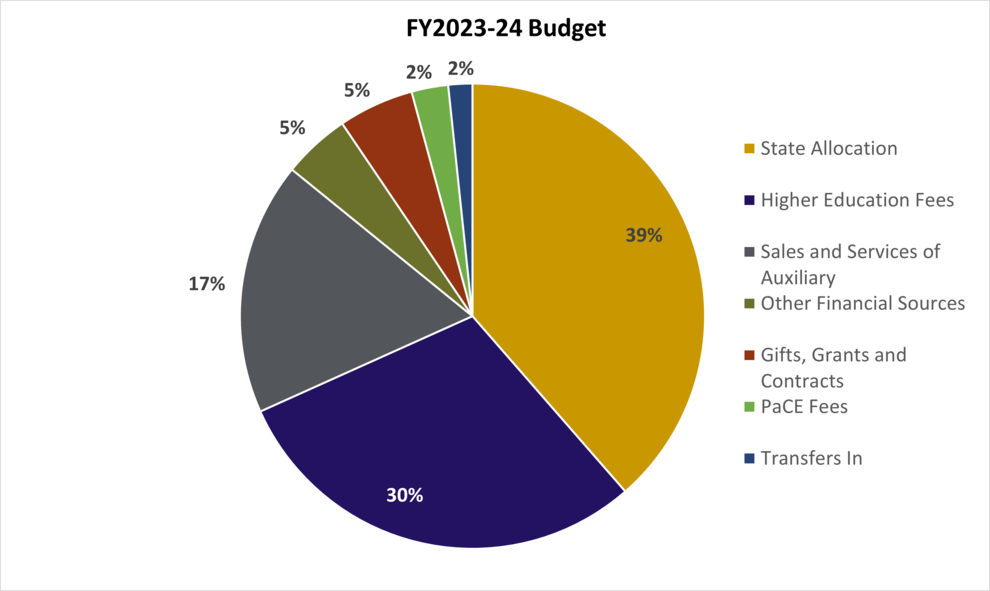
| Revenue Source | Percentage |
|---|---|
| State Allocation | 39% |
| Higher Education Fees | 30% |
| Sales and Services Auxiliary | 17% |
| Other Financial Sources | 5% |
| Gifts, Grants and Contracts | 5% |
| PaCE Fees | 2% |
| Transfers In | 2% |
How is our money spent?
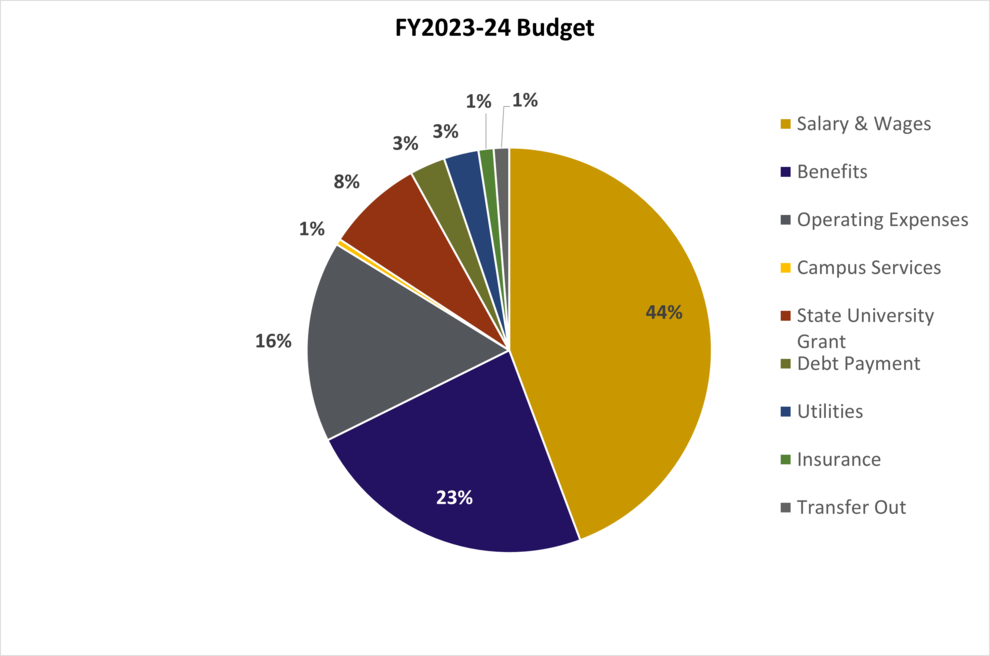
| University Expenditures | Percentage | Description |
|---|---|---|
| Salary and wages | 44% | The salaries and wages of faculty and staff constitute the campus’ largest expense category. SFSU to offer compensation comparable to peer institutions so that we can recruit and retain the best instructors and staff to support the campus’ mission. |
| Benefits and retirement | 23% | Related to salaries and wages, the benefits that we provide to employees constitute the second-largest category of expenditures. Benefits and retirement is one of the lines in the budget over which we have very little control. |
| Operating expenses | 16% | This includes goods and services that are used in day-to-day campus operations, from laboratory materials to office supplies and from contractual services to business travel. |
| State university grant | 8% | This is SFSU financial aid program that supplements other existing aid programs such as Pell Grant, Cal Grant, Middle-class scholarship. |
| Debt payment | 3% | This category of expenses includes the payments SFSU makes on the loans it has taken out to fund past capital projects and other activities. |
| Utilities | 3% | Similar to the utility bills a person pays at home, SFSU pays for the energy and resource needs of the campus, including electricity, water, natural gas, waste disposal and more. Given the needs of labs and other energy-intensive facilities, these can be significant costs. |
| Campus services | 1% | Includes costs for the services provided by the campus administrative units such as facilities, information technology, mail, copier program, etc. |
| Insurance | 1% | Sometimes called the Risk Pool, this is the costs the University pays for insurance of property, auto, athletics program, workers compensation, industrial disability (IDI & IDL), travels and others |
| Transfer out | 1% | Transfers into capital and deferred maintenance programs. |
The budget cycle: State of California budget

| Month | Description |
|---|---|
| September | In the September of the prior fiscal year, CSU Trustees adopt the Operating Budget Request for submission to the Governor. |
| January | The Governor’s Budget is submitted to the Legislature. |
| February | The Legislative Analyst’s Office review of Governor’s Budget is published. |
| May | Revision to the Governor’s Budget is released. |
| June | The State budget is enacted. |
California State University Budget Process

Also known as the Governor's Budget process, the state's budget process begins in November of the year before the fiscal year for which the budget is to be enacted.
| Month | Budget Process |
|---|---|
| September | CSU Trustees adopt the Operating Budget Request for submission to the Governor. |
| January | The Governor’s Budget is submitted to the Legislature. |
| February | The Legislative Analyst’s Office publishes its review of the Governor’s Budget. |
| May | The Governor’s Budget Revision is released. |
| June | The state budget is enacted. |
SFSU budget process
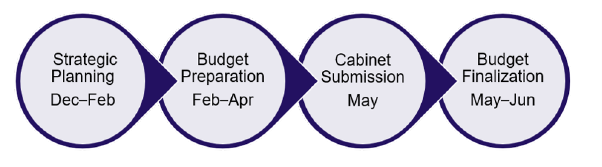
| Month | Description |
|---|---|
| December–February | Strategic Planning (Campus Budget Framework) |
| The president's cabinet and CFO Office review the campus expense projections, the enrollment plan, and the projected state allocation from the CSU Operating Budget Request for the next fiscal year. Based on those estimates, the campus develops scenarios and shares them with divisions as temporary, multi-scenario budget targets. | |
| February–March | Budget Preparation (campus units develop budget plans) |
| With the University Budget Committee scenario enrollment and budget targets approved, the deans and/or vice presidents of each division work with their staff to determine how to meet their temporary targets. A vice president may choose to meet temporary targets through the generation of new revenue and/or cost reductions. | |
| April | Cabinet Budget Submission (begin meetings with the division/colleges/cabinets) |
| Once divisional budgets have been finalized and submitted to each division's deans and vice presidents, they meet to discuss their plans and the challenges and opportunities their divisions face. | |
| When budgets are submitted to the Budget Operations and Administration department and the CFO, additional working scenarios may be required to account for any adjustments discussed at the meetings. | |
| Additional adjustment to the campus scenario is to be completed by the time the May Revision to the Governor's Budget is communicated to the University by the Chancellor's office. | |
| May–June | Budget Finalization (approval and upload) |
| Having gained perspective from their review of budget submissions and their meetings with division leaders and with the final instruction received from the CO in the form of the June Budget Memo, the president, vice presidents and CFO then make final decisions about budget allocations for each division. Finalized budget allocations are released to each dean and vice president, who then use those targets to refine budgets for each department within their division. During this last step, the president, vice presidents and CFO also make strategic funding decisions that reflect campus priorities. |
Full budget process
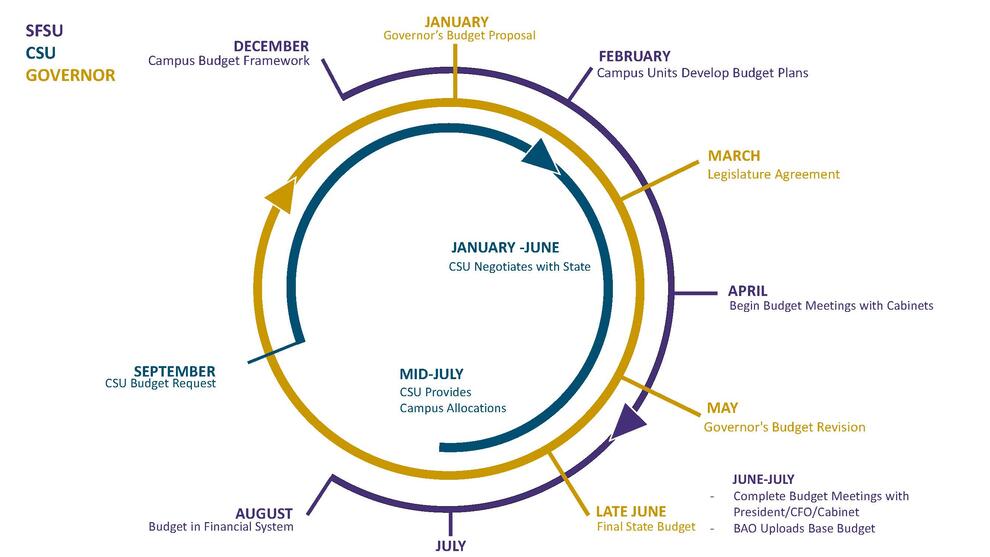
| Month | Description |
|---|---|
| September | (of the year before the Fiscal Year being planned) |
| CSU Budget Request | |
| December | (of the year before the Fiscal Year being planned) |
| SFSU Campus Budget Framework | |
| January | Governor's Budget Proposal |
| January–July | CSU negotiates with the State |
| February | SFSU Campus units develop Budget plans |
| March | Governor's Legislature Agreement |
| April | SFSU begins budget meetings with Cabinets |
| May | Governor's Budget Revision |
| May–June | SFSU Budget approved and finalized |
| SFSU Budget department uploads Base Budget | |
| Late June | Governor signs final State Budget |
| Mid-July | CSU provides campus allocations |
| August | SFSU uploads FIRMS Budget Submission to Chancellor's Office |
Important Concepts
SF State University Funds

| Category | Description |
|---|---|
| Current Funds | Revenue used for current operating activities, such as tuition revenue, sponsored research support, state appropriation, endowment payout, and other investment income. These are usually in the General Fund. Funds include Fund 485 – General Fund, Fund 491 – Special Project Fund, and Fund 496 – Miscellaneous Trust Fund. |
| Restricted Funds | Federal and state grants and contracts, endowment income, federal and state financial aid, and restricted gifts. These funds support research, scholarships, public service, and financial aid and generally cannot be used for purposes other than those for which they were received. |
| Capital Funds | Funds used for capital projects, such as construction of new facilities, nonrecurring maintenance, or debt service. These funds cannot be used for other purposes. |
| Student Loan Funds | Funds available to be borrowed by students. These funds cannot be used for other purposes. |
Glossary of budget terms
Quick definitions to help you understand budget language at a glance.
The permanent funds given to each unit so that it can carry out its mission each year.
The plan for where revenues adequate to run the University are forecast to come from, and how those funds should be allocated each year.
The budget allocations memos distributed by the CSU Budget Office to provide information to the 23 campuses regarding fiscal year budgets or other important directives related to allocations.
Funds left unspent at the end of the fiscal year in the General Fund. They do not reoccur each year.
The CSU and SFSU fiscal operations begins on July 1 and ends on June 30. Most spending (except for reserve funds or RT funds) has to be completed within this period.
An important measure of the number of students at SFSU.
- One FTES equals 1 course credit units × enrollment / 15 semester units taken;
- For graduate students, one FTES equals 12 semester units per term.
The different buckets in which monies are kept. Each operates as its own system, with spending and revenues received in each of these. The main fund is the General Fund, through which most revenues and out of which most spending, occurs.
The main bucket of funds for organizations. Funds have to be approved by the Legislature and Governor then are sent to the CSU for distribution to be each campus. Money in this fund generally need to be spent by the end of the fiscal year.
In January, the California Governor proposes a plan for obtaining adequate revenues and a plan for spending those revenues. The Legislative Analyst’s Office (LAO) analyzes the proposal and publishes its findings. The Governor revises the proposal in May in what is called the May Revise. The Legislature reviews this proposal and then votes to change and/or approve it. After, the Governor then signs what the Legislature has passed, the allocated funds then go to State agencies like the CSU.
The number of people (like students) at any one time.
Funding that is not part of a unit’s permanent base but rather, comes in one pot and should not be expected to be allocated again.
Another bucket of money, where funds set aside for later spending are kept. Not all types of funds can have funds remaining in them at the end of the fiscal year, to be carried forward into the next fiscal year.
A restricted fund is a reserve account that contains money that can only be used for specific purposes. Restricted funds provide reassurance to donors that their contributions are used in a manner they have chosen.