Procedures
Student Conduct Procedures for the California State University System
Office of Student Conduct (OSC) follows CSU Executive Order 1098 which governs all Student disciplinary matters systemwide, except that as noted in Article IV of this Policy and in the CSU Nondiscrimination Policy.
- Executive Order: 1098
- Effective Date: August 14, 2020
- Supersedes: Executive Order No. 1098 (June 23, 2015)
- Title: Student Conduct Procedures
- CSU Executive Order 1098 can be viewed at: CalState Student Conduct Procedures
Relevant Executive Orders
Office of Student Conduct (OSC) follows CSU Executive Order 1098 which governs all Student disciplinary matters systemwide, except that as noted in Article IV of this Policy and in the CSU Nondiscrimination Policy.
- CSU Executive Order 1096 at Calstate Policy and Procedures
- CSU Executive Order 1097 at Calstate Systemwide Policy
Appointments
Students are expected to attend meetings scheduled with the Office of Student Conduct (OSC). Appointments may be rescheduled only in emergency circumstances and will be rescheduled within 72 hours of the original appointment.
To request a rescheduled appointment, you must contact OSC no later than 24 hours before your original appointment by:
- Calling (415) 338-2032 and leaving a voicemail
- Emailing conduct@sfsu.edu with contact information
- Monday through Friday between 8:00a.m. - 4:30p.m.
- Provide contact information for you to be reached at
Note: Failure to attend any scheduled appointment may result in further action by OSC.
Formal Hearings involve significant preparation. Dates scheduled for Formal Hearings are firm.
Reasonable Accommodations: If you require accommodations due to a disability, contact OSC at least five business days before your scheduled meeting.
OSC Resolution Process
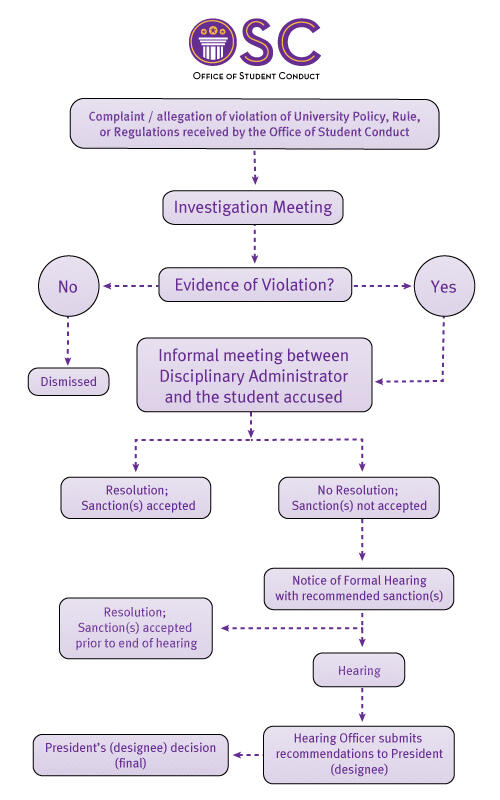
OSC Resolution Process Diagram - Text Version
When the Office of Student Conduct receives a report of a possible infraction, the office notifies the student of the alleged misconduct and the student is scheduled for a meeting with the Student Conduct Administrator.
A student may confer with family members or advisors at any stage in the informal or formal process.
Informal Disposition
At the initial meeting, the student is advised of his or her rights and informed of the evidence supporting the allegation. The student is encouraged to respond and participate in an open and honest discussion of the incident. Possible resolutions to the incident emphasizing the personal growth and development of the student are outlined and are usually determined at this time. In an informal disposition, the student must consent to any imposed sanction.
Formal Disposition
If an informal disposition cannot be achieved, formal procedures commence by providing the student with a written Notice of Hearing as required by CSU Executive Order 1098, Article III, C. The student receives a link to CSU Executive Order 1098, Student Conduct Procedures, describing the applicable procedures.
The formal hearing process provides a prompt, fair and impartial resolution of the incident. A Hearing Officer appointed by the President of the University, or their designee, conducts a closed, confidential proceeding. The student's attendance is not mandatory. Both the student and the Student Conduct Administrator may offer evidence and question witnesses. The Hearing Officer may also question witnesses. An advisor may accompany the student and the Student Conduct Administrator. Student disciplinary hearings are not courtroom proceedings and formal rules of evidence (e.g. hearsay exclusion) do not apply. Written minutes and/or audio recordings of the hearing are kept.
After the hearing, the Hearing Officer submits a written report to the University President or designee within ten working days. This report contains factual findings and conclusions regarding whether or not the conduct constitutes a violation and, if so, recommendations regarding the sanction(s) to be imposed. A violation must be proved by a preponderance of the evidence: there is more evidence than not that the accused committed the violation. Any findings, conclusions, or recommendations must be based only upon evidence received at the hearing. The President or the designee then makes a final determination based on the report. The President's, or designees, decision is final and may not be appealed.
Student Safety
The University's primary consideration is student safety. Students should not be deterred from reporting incidents of possible alcohol poisoning or drug overdose based on concerns that they might be disciplined in accordance with the Standards for Student Conduct.
Possible OSC Sanctions
A designated period of time during which the privileges of continuing in student status are conditioned upon future behavior. Conditions may include the potential loss of specified privileges to which a current student would otherwise be entitled, or the probability of more severe disciplinary sanctions if the student is found to violate any University rule during the probationary period.
Temporary separation of the student from active student status or student status.
- A Student who is suspended for less than one academic year shall be placed on inactive Student (or equivalent) status (subject to individual Campus policies) and remains eligible to re-enroll at the University (subject to individual Campus enrollment policies) once the suspension has been served. Conditions for re-enrollment may be specified.
- A Student who is suspended for one academic year or more shall be separated from Student status but remains eligible to reapply to the University (subject to individual Campus application polices) once the suspension has been served. Conditions for readmission may be specified.
- Suspension of one academic year or more, withdrawals in lieu of suspension, and withdrawals with pending misconduct investigations or disciplinary proceedings shall be entered on the Student’s transcript permanently without exception; this requirement shall not be waived in connection with a resolution agreement.
Permanent separation of the Student from Student status from the California State University system. Expulsion, withdrawal in lieu of expulsion, and withdrawal with pending misconduct investigation or disciplinary proceeding shall be entered on the Student’s transcript permanently, without exception; this requirement shall not be waived in connection with a resolution agreement.
Compensation for loss, damages or injury. This may include appropriate service and/or monetary material replacement.
Consistent with California Education Code Sections 69810 et seq., scholarships, loans, grants, fellowships, and any other types of state financial aid given or guaranteed for the purposes of academic assistance can be conditioned, limited, cancelled, or denied.
Assignments, such as work, research, essays, service to the University or the community, training, counseling, or other remedies intended to discourage a repeat of the misconduct or as deemed appropriate based upon the nature of the violation.
A designated period of time during which the student is not permitted: (i) on University Property or specified areas of campus. (See California Penal Code section 626.2.); or (ii) to have contact (physical or otherwise) with the complainant, witnesses or other specified persons.
Policies and Procedures
Title IX
The Office for Civil Rights and Title IX is committed to ensuring that all members of the SFSU community can fully participate in university educational and employment opportunities free from discrimination, harassment, sexual misconduct and related retaliation.
Student Organization/Club Conduct Process
Our goals include prevention campaigns that provide workshops, outreach tables, campus-wide health campaigns, and substance-free events. Using a harm reduction approach to substance use education, we hope to increase social support and knowledge of the safe utilization of substances in the SFSU community to prevent harms associated with substance use.
The OSC Resolution Process
When the Office of Student Conduct receives a report of a possible infraction, the office notifies the student of the alleged misconduct and the student is scheduled for a meeting with the Student Conduct Administrator. A student may confer with family members, or advisors at any stage in the informal or formal process.