About Nursing
History of the School of Nursing
San Francisco State University Nursing Program began as a School Nurse Program in 1955. The Department of Nursing was placed in the Division of Education (now known as the College of Education) because of the emphasis on school nursing. The school nurse emphasis was discontinued in the mid-1960s due to the need for a basic baccalaureate program that prepared nurses for all practice settings. Funded by a curriculum development grant from the U.S. Department of Health, Education, and Welfare, the baccalaureate program underwent a major curriculum revision during the years 1975 – 1978. The Department of Nursing remained until 1994 when a reorganization of the University resulted in the creation of the College of Health and Human Services and with it, the creation of the School of Nursing.
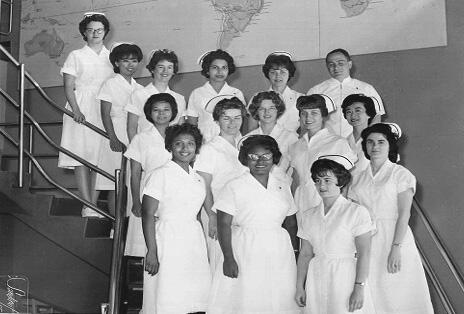
Today, the School of Nursing is one of eighteen schools, programs and departments within the College of Health and Human Services at SFSU. The Department of Nursing was initially housed in the Education building, or Frederick Burk Hall as it is called today. In 1970, the Department of Nursing moved to Mary Ward Hall until 1972, when the Department was moved to the Science building. Now known as the School of Nursing, the School moved once more to its final home in Burk Hall building in 1996. School of Nursing and its faculty transformed a single focus bachelor’s degree program (school nursing) into a state-of-the-art curriculum that prepares nurses for practice in the 21st century. The equally innovative graduate program prepares nurses who manage health care systems, provide nursing education, and deliver advanced practice nursing services (as nurse practitioners or clinical nurse specialists).
School of Nursing is a leader in developing new and creative programs that are responsive to the healthcare needs of the people of California and the nation. The School is acutely aware of its vital role in preparing culturally competent nurses and embraces diversity and demonstrates this commitment through its multi-cultural, multi-ethnic student and faculty population.
Master’s Program in Nursing
In the spring of 1979, the Department of Nursing conducted a comprehensive feasibility study in order to establish the need and availability of resources for the development of the Master of Science in Nursing Degree. The study revealed a strong community need for a Master’s Degree program designed for the working nurse to prepare leaders for health care agencies in the areas of Nursing Management/Administration and Teaching/Inservice Education. The first class of students was admitted in January, 1984. In 1986, expansion of the MSN program from 30 to 36 units to accommodate changing curriculum needs was approved. In 1988, two new entry tracks were added to the MSN program: (1) for RNs with a BA/BS in a field other than nursing, and (2) the first generic master’s in nursing program west of the Mississippi. In the generic master’s program, non-nurse college graduates complete the undergraduate nursing courses and the master’s curriculum in three years. An emphasis in Case Management/ Long Term Care was added in 1991 and a Family Nurse Practitioner emphasis was added in 1994 and an emphasis in Entrepreneurial Leadership in 1996. The School of Nursing offers a certificate as a Family Nurse Practitioner for nurses with a master’s or doctoral degree in nursing and one in Entrepreneurial Leadership. The master’s program was initially accredited by the National League for Nursing in 1988, then by the National League for Nursing Accrediting Commission until 2003, and by the Collegiate Commission on Nursing Education since 2003. Today there are four emphases for study: Entrepreneurial Leadership, Clinical Care Management, Public Health and Community Nursing, and Family Nurse Practitioner.
Nu Psi Chapter of Sigma Theta Tau, International
The faculty and students of the Nursing program established a Nursing Honor Society in 1986. Through the collaborative efforts of the faculty, students and community members, it was chartered as the Nu Psi chapter of Sigma Theta Tau (the International Honor Society of Nursing), in April 1994. The society began with approximately 150 charter members. Alpha Eta, located at University of California School of Nursing, mentored the SFSU Honor Society and was instrumental in the founding of the chapter.
Mission
The School of Nursing educates and empowers nurses to be agents of change to transform health care. We commit to co-create change by deconstructing, disrupting, and dismantling systems of oppression through the nursing profession. We foster evidence-based nursing, ethical decision-making, sound clinical judgment, leadership and holistic compassionate care using a justice perspective. We promote diversity in the nursing workforce and commit to recruit, retain, support, nurture, and mentor our students, faculty, and staff to support equity and inclusion.
Shared Principles
Using our shared principles, we confront structural, systemic, and institutional inequities in health care, education, the environment, policies, and social determinants of health affecting individuals, families, and communities. We value:
- Justice, Equity, Diversity, Inclusion
- Promote health equity, inclusion, justice, diversity and anti-oppressive ideologies by creating change in evolving healthcare systems. Advocate for racial and ethnic representation of the local community by increasing the number of nurses from underrepresented groups in nursing historically and systemically marginalized groups.
- Student-Centered Learning Environment
- Establish an inclusive educational setting for students with diverse learning styles and needs. Maintain a student-centered academic environment that promotes integrity, compassion, critical thinking, clinical judgment, leadership, cultural humility and a social consciousness to address health equity.
- Community
- Collaborate with local institutions, organizations, and agencies of social change in efforts to foster just and inclusive compassionate care.
- Accountability
- Creating an environment that holds individuals and communities accountable for the impact of oppressive attitudes, bias, actions and words. Committing to applying moral courage to prevent similar harms from repeating and establishing practices to move through the world with greater awareness.
Philosophy
We foster student growth and development embracing their richly diverse cultural and ethnic backgrounds, recognizing the individual differences in learning styles and goals, and adapting support systems to help students fulfill their educational goals. Building on a foundation of knowledge from nursing and other disciplines such as psychology, sociology, philosophy and anthropology, graduates of this program will collaborate with other healthcare disciplines (i.e. medicine, physical therapy, psychology, social work, and others) to provide compassionate and ethical care along the health-illness continuum throughout the lifespan. These educational endeavors affect the healthcare environment and positively influence health outcomes of individuals, families, communities and populations. We are committed to professional development of faculty, staff and students using our conceptual model, which guides our academic activities. We provide excellent nursing education and academic activities emphasizing patient-center care, patient safety, teamwork and collaboration, evidence-based practice, quality improvement, informatics, leadership and lifelong learning for the students as well as faculty and staff. The following objectives are based on this philosophy:
- To provide curricula that reflects human diversity and encourages critical thinking, clinical judgments, and social and cultural awareness
- To provide a learning environment conducive for students with diverse learning styles and needs
- To develop clinicians, leaders, advocates and change agents to function in evolving healthcare systems
- To increase the number of nurses form underrepresented groups in nursing
- To prepare nurses who support, use and disseminate research in practice
- To serve the local and global community through faculty and student leadership, consultation research, and clinical practice.
Accreditation
The baccalaureate degree program in nursing, master's degree program in nursing, and family nurse practitioner program at San Francisco State University is accredited by the Commission on Collegiate Nursing Education, 655 K Street NW, Suite 750, Washington, DC 20001, 202-887-6791.