University imaging center trains 1,000th student, fosters future scientists
Students gain marketable skills and mentorship at the cutting-edge facility, paving the way for success in research and industry
- By Kanaga Rajan
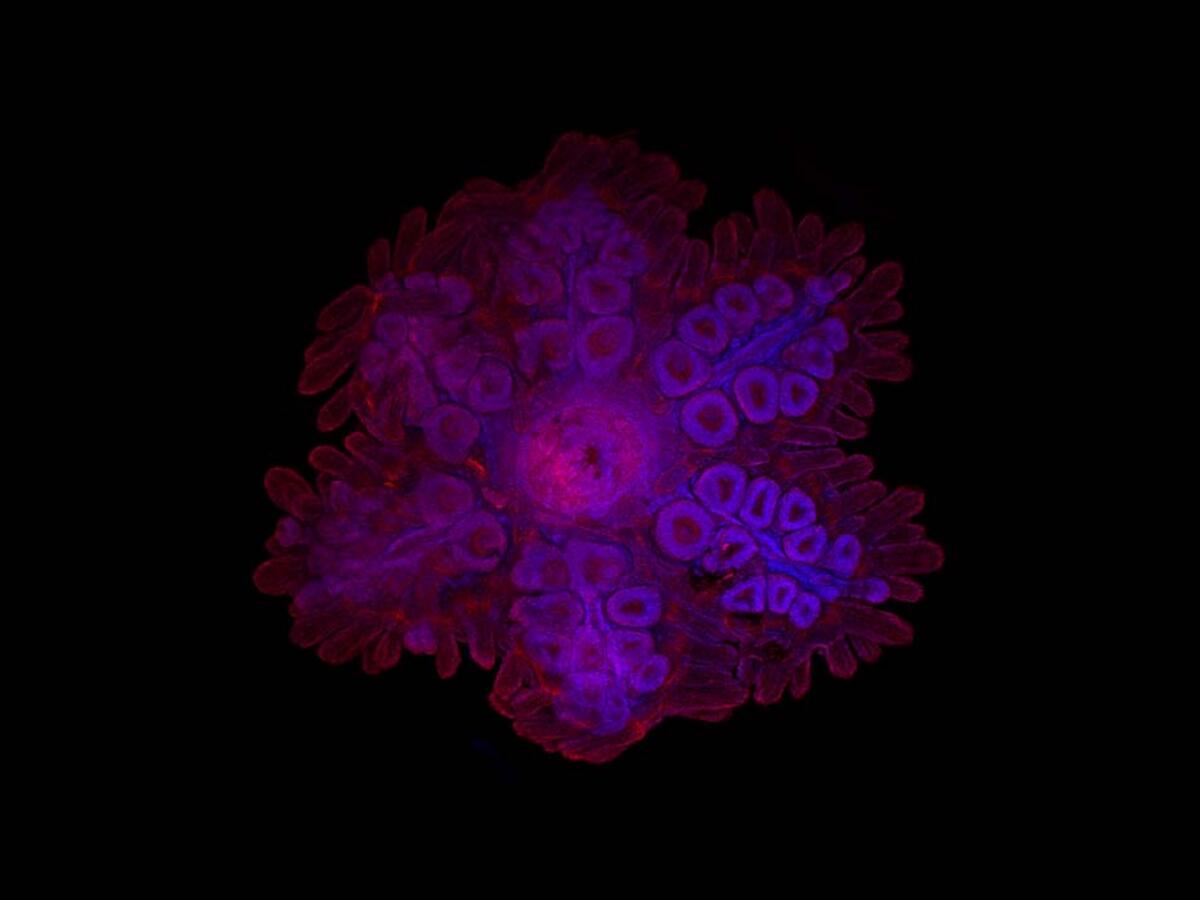
Back in grade school, many of us read biology textbooks filled with illustrations of cells, organelles and chromosomes. But in the real world, scientists have methods to light up cells (sometimes colorfully) to view these elements with their own eyes. At San Francisco State University, these researchers are students using the on-campus Cell and Molecular Imaging Center (CMIC).
“When you are the person who gets to prepare the samples and put it in the microscope and are able to take those pretty images … wow, it’s amazing. I didn’t know I could do that,” said Judy Abuel (B.S., ’22; M.S., ’24).
The CMIC recently achieved a major milestone: It surpassed 1,000 student trainees since 2003. Many of those were master’s students, and even more were undergraduates getting a taste of hands-on high-tech science in Hensill Hall. Approximately 36% of all CMIC students are from underrepresented communities.
The CMIC provides San Francisco State researchers access to cutting-edge equipment, data analysis tools and extensive training. It’s that last point — the extensive training — that is key to the students’ success.
Marketable skills
“Ultimately, we’re trying to get students jobs, so a lot of the CMIC’s mission is to try to make sure that they’re trained on up-to-date scientific equipment and that they get research experience, which will make them more competitive at getting jobs,” CMIC Director Annette Chan said. Faculty like Biology Professor Diana Chu periodically write grants to ensure the CMIC has the best equipment, including awards from the National Science Foundation Major Research Instrumentation program.
“I think when [students] leave, they can feel more confident that they understand what they are doing. They know how to use the technology that’s relevant to where they are going. It’s very impressive,” Chu said. The resulting high-quality data helps students publish in scientific journals and present at local, national and international conferences, making them competitive for graduate school and industry.
“I did an oral talk last year at a conference. That was my first time showing my pretty [CMIC] images to people, and I could tell that a lot of people were so surprised because I was just a first-year master’s student,” said Abuel, who just started working on her Ph.D. at UC Davis, largely because of her CMIC experience. Like most students, Abuel came to the CMIC with no prior advanced microscopy training.
“I am pretty confident that if I go to a different institution and use their microscope, I would not need a lot of help trying to figure out how to use it,” she added, crediting the variety of CMIC equipment and training.
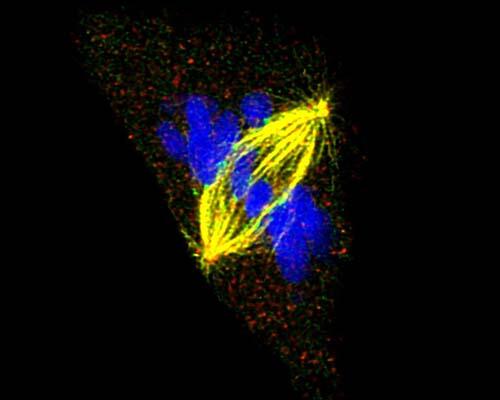
Image of chromosomes segregating during cell division by Judy Abuel (B.S., ’22; M.S., ’24), now a UC Davis Ph.D. student.
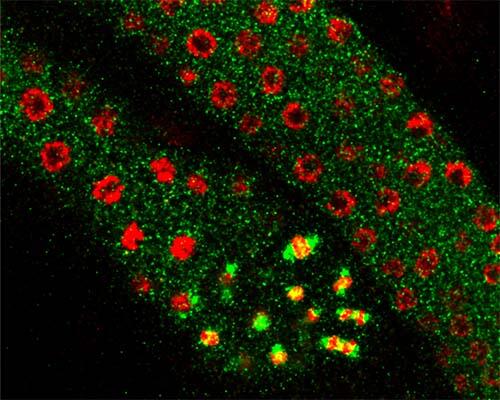
Image of dividing cells in a C. elegan worm by grad student Allen Michael Ramsey.
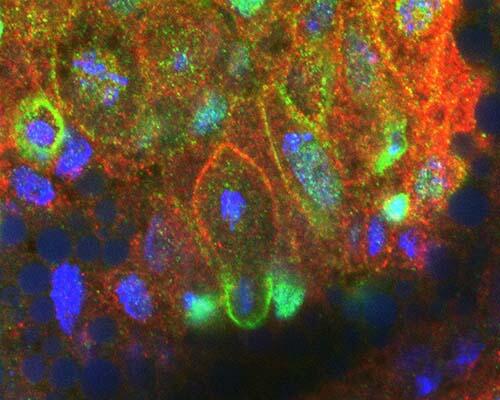
Image of dividing neural stem cells by alum Gerson Ascencio (B.S., ’21; M.S. ’23), now a Stanford Ph.D. student.
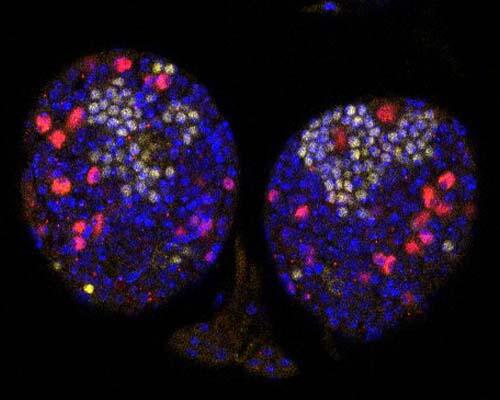
Immunostaining of fruit fly (drosophila) larval brain by grad student Stephanie Uzordinma Awuzie.
Training experts
Molecular Biology senior Angelo Orozco first used the CMIC as a sophomore to learn flow cytometry (a way to quantify cells based on physical/chemical properties), a skill widely used in biomedical research and industry. He says it was stressful but the experience gave him a deep understanding of the technique so he could mentor his colleagues.
“I was the [lab’s] resident flow cytometer expert so I had to teach all of these master’s students who might need it for their projects,” Orozco said.
These days, he’s shifted to the CMIC’s microscopes. He’s surprised by the variety and caliber of experiences he’s had this early in his career.
“It just opens so many doors. Even if you don’t use it in the future, it’s still something to show that you are getting out there and you’re learning new things. It also helps you gain new perspectives on anything you might do in the future,” he explained.
Orozco and Abuel admit that working in the CMIC can be intimidating. Coming in with minimal or no prior experience, they were trained to independently use equipment that costs hundreds of thousands of dollars. Damaging a device can be costly, ruin experiments and halt work in multiple labs for weeks or longer. However, Chan credits students for the fact that the CMIC equipment rarely encounters issues.
‘The best mentor’
The students and Chu stress Chan’s role in the CMIC’s story. Her expertise, mentorship and patience are critical to the CMIC’s success, they say.
“She’s probably one of the best mentors I’ve ever had,” Orozco said. “I would be in the CMIC very late at night, and [if I have a] question or anything went wrong, all I had to do is email her and she would respond very quickly. She’s always there for you.”
Chan, the sole person running the day-to-day CMIC operations, trains multiple students per week. Each training can last multiple hours and span several days. This level of output is rare and impressive.
“I think [Annette] provides the most thorough training you can imagine,” Chu said. “I think that’s very different from other facilities and facility managers. I think the training [students] get at CMIC is one of the best anywhere.”
As for Chan, she beams with pride thinking of the students working at the CMIC. She’s inspired by the students and in awe of their work, dedication and conscientiousness.
“I always tell people I get the cream of the crop at San Francisco State because these students are highly motivated,” Chan noted. “At SF State, teaching is a big component, which is why I love it here.”
Learn more about the College of Science & Engineering’s centers and research facilities.