SF State Fulbright scholar studies millennia of climate change via trees
Triana Anderson’s thesis is the foundation for her Fulbright project studying Chilean coastal climate change
- By Kanaga Rajan

Remember in grade school learning to count tree rings to determine a tree’s age? Turns out tree rings can reveal climate information, too, says San Francisco State University student Triana Anderson. For her thesis project, she is applying a novel approach to use trees as a gauge for coastal climate change over thousands of years. Her expertise has earned her a Fulbright scholarship to do a parallel project in Chile for nine months after she graduates this fall.
“The idea is that Chile and California have two very parallel climate systems, but one is in the northern hemisphere. There are a lot of questions that climate scientists have about how coastal systems will change as the planet warms,” said Anderson, an Earth & Climate Sciences master’s student at San Francisco State. Studying trees in California and Chile will help identify how climate change differs in the two hemispheres.
Anderson has unknowingly been preparing for this Fulbright adventure her whole life. Having grown up in Northern California, she spent a lot of time outdoors listening to her dad describe how the coast has changed since his childhood. “I think that helped bring a climate change perspective at a young age — even though I wouldn’t have called it that as a kid,” she said.
Her choice to study in Chile? That was also intentional. She attended Spanish-speaking immersion schools since she was 5 years old, loving it so much she minored in Spanish as an undergrad.
“I think it’s always been a goal to go live in a Spanish-speaking country and fully solidify those pathways that are in my brain,” she explained. She’s excited that a Fulbright experience will fuse her scientific and personal goals.
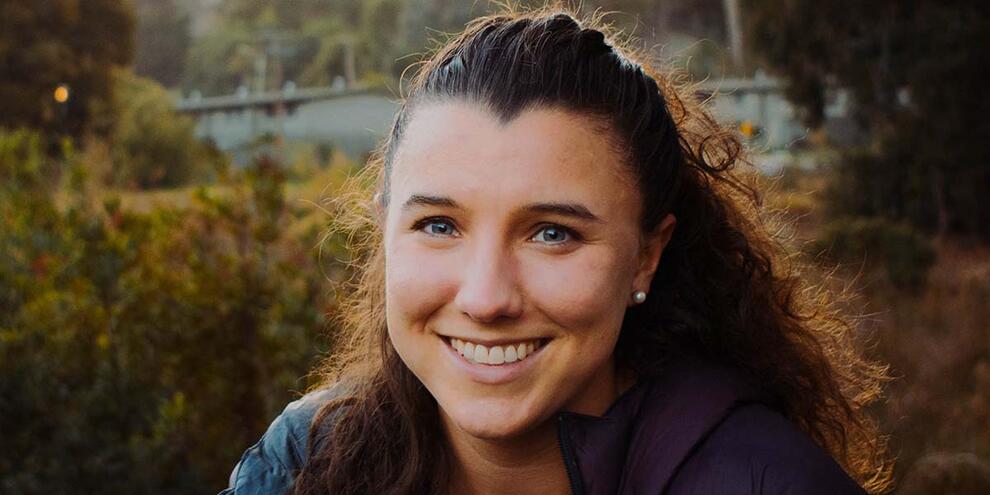
The novel technique she’s taking to Chile was developed at SF State. Anderson came to the University after cold calling and instantly clicking with her future thesis adviser, Associate Professor Alexander Stine. He introduced her to the idea of using trees to evaluate climate change, and she was hooked on the idea.
Traditionally, scientists — like those in Chile — measure variability in tree ring width to determine climate fluctuations. Some researchers glean more info by looking at the cellular structure of wood but are limited by the small sample of wood cells they can manually assess under a microscope.
For her graduate work, Anderson coupled a new high-resolution imaging technique to assess cellular structure with an artificial intelligence algorithm to take mass measurements of lots of cells from lots of trees. It allows her to look at both temperature and precipitation changes together, whereas traditional methods force scientists to focus on temperature or precipitation separately. Because she can look at larger sample sizes, she can also average out noise from confounding variables like insect infestations or competition between species.
She’s been using this approach to study changes in California’s coastal climates. Studies show a decline in coastal fog over the last 100 years, but Anderson points out that’s a relatively short period of time when considering climate trends. Her study uses coastal redwoods to look at climate changes over 2,000 years.
“[Redwoods] live that long, which is insane. It’s crazy to think that there are living organisms that have experienced all of that history,” she said. The Chilean researchers are eager to apply her approach in their studies.
As a graduate student, Anderson was supported by the Monterverdi Fellowship and the Professor Emeritus Dave Dempsey and Rebecca Douglass Scholarship in Earth and Climate Sciences.
She’s not entirely sure what will come after the Fulbright, but she hopes teaching is in the mix. At SF State, she excitedly elected to teach an oceanography class for non-science majors. She’s glad that community work is part of her Fulbright program, too. She’s hoping to teach science education or youth girls’ sports in Chile.
“I love working with kids. I think it’s so cool to watch their brains make all those little connections,” she explained, noting that the youngest community members are the ones to be most impacted by climate change.
Visit the Fellowships Office for information about Fulbright and other programs. Visit the Earth & Climate Sciences website to learn more about research and academics.