Studying Karl the Fog: SFSU researchers help launch major coastal study
Associate Professor Sara Baguskas will help establish a multi-university fog-monitoring network
- By Kanaga Rajan

If you live in the Bay Area, you know Karl the Fog. Many of us have a love-hate relationship with our misty friend and how it influences our outdoor plans. However, Karl — aka coastal fog — is vital for our ecosystem and what makes the California coast special.
The Heising-Simons Foundation awarded San Francisco State University School of the Environment Associate Professor Sara Baguskas and her collaborators a five-year, $3.65 million grant (approximately $730,000 per university) for the Pacific Coastal Fog Research (PCFR) project. The Heising-Simons Foundation is a family foundation that works with its partners to advance sustainable solutions in climate and clean energy, enable groundbreaking research in science, enhance the education of our youngest learners and support human rights for all people.
“We are working together to establish a fog-monitoring network that spans the entire coastline and different ecosystems, from redwood forests to maritime chaparral to agriculture, urban and bluff scrub,” Baguskas said. Not only will this new project monitor current conditions, but it will allow scientists to better predict future patterns. “All these are different ecosystems that Californians love and are important to people and biodiversity.”
The team will set up sensors along the coast to capture information about fog events, such as moisture, radiation, energy balance, temperature, relative humidity and more. At SFSU, Baguskas, who specializes in how plants respond to environmental (fog) changes, will collaborate with School of the Environment Director and Professor Andrew Oliphant, an expert in measuring changes in surface climate and associated land-atmosphere exchanges of carbon and water.
“It’s really interesting, and I’m really excited about the work that’s being done to create this network,” said Geography master’s student Harvey Hightower (B.A., ’23), noting its potential for conservation efforts and fog-water collection as a supplemental water source. “We can’t figure out these kinds of plans or know if it’s feasible without a network and more research.”
For his thesis, Hightower works with Baguskas to study the relationship between coastal fog and an invasive plant species spreading with changing grazing patterns at Point Reyes National Seashores. The project is a major step toward his professional goal of working on restoration of native California grasslands.
The PCFR group hopes its work will have a social impact and inform society’s ability to manage coastal resources in a changing climate. A major strength of this project is the range of expertise at the collaborating institutions — SFSU, Indiana University Bloomington, Scripps Institution of Oceanography, CSU Monterey Bay and UC Santa Cruz. As part of this work, the scientists will also partner with UC Nature Reserves (UC Santa Barbara, UC San Diego, UC Santa Cruz, UC Berkeley and UC Davis), farm management professionals (such as farm managers and irrigation managers) and more.
“We’ve never had this opportunity to work together and coordinate, to ask big questions about this [fog] phenomenon that is going to be more and more important as climate continues to change,” Baguskas said. Pooling expertise and resources means the group will have a better understanding of fog water fluxes, fog water chemistry and biology, spatial and temporal patterns of fog, atmospheric models and more.
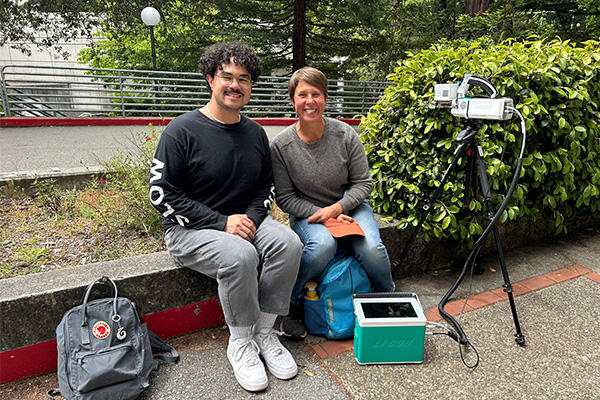
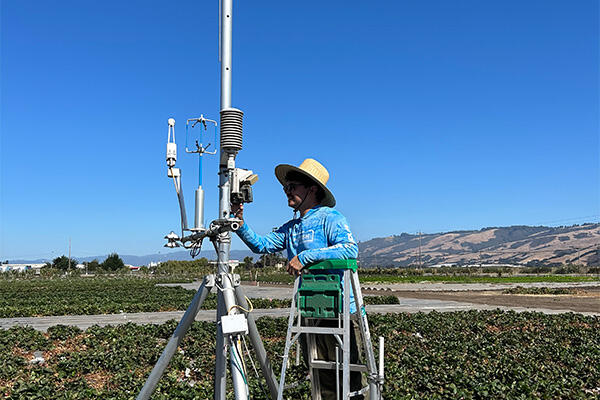
Baguskas and Oliphant are excited to get more students involved in research through this five-year project. Student researchers like Hightower will get research experience and grow their scientific network by working with collaborators. She aims to possibly establish one fog monitoring station on campus, making it easier for students to engage.
“I always look forward to hearing how our students are perceiving the world, especially in science, where there’s a need for more diverse perspectives and voices,” she said. “Over time, I’ve learned so much about why science matters through our students. To be a part of their scientific journey, watching them apply their knowledge and skills and strength into the world of new jobs and grad positions, has been enriching.”
Baguskas’ former student Kapewa Hopfe (B.S., Environmental Science, ’24; B.A., Geography, ’24) is now a conservation technician at Stanford, restoring habitats and maintaining native populations of species in the university’s preserves and creeks. As an undergraduate, his first research experience included prior coastal fog research projects with Baguskas and Oliphant.
“It really opened my eyes to career paths of doing research outside, doing field work and having a nature-based career. It influenced me into doing conservation work I’m doing now,” he said, adding that he gained a lot of skills. “I was working with a lot of experience with different scientific equipment that I can leverage for jobs. I also had a lot of experience with data entry and field work experience.”